
One Day, Lasting Momentum: A Case Study in Launching a Giving Day

For eight years, Mila has been the Director of Annual Giving at Alderbrook University*, a regional institution in the Northeast with a $160 million annual operating budget and roughly 6,000 undergraduate and graduate students. Alumni Relations and Advancement maintained connections to around 100,000 alumni and supporters. 

At the homecoming game, Mila found herself chatting with Vanessa, a young alumna, three years out, dressed head-to-toe in Alderbrook blue. When Mila asked Vanessa if she had given any consideration to the college’s recent appeals, the alumna paused for a beat. “I love this,” she said, gesturing toward the crowd. “But those appeals aren’t really talking to me. They’re for someone ten or fifteen years further along, someone who can write a real check. What am I going to give, twenty dollars? That’s not going to make a difference.”

The comment stayed with Mila. It wasn’t apathy she had heard, but a graduate who showed up for anything that felt like community, having decided her gift would be too small to matter.

What a Giving Day Actually Is

Mila began looking into whether the “giving day” concept that she’d heard about at conferences but never seriously considered might reach alumni like Vanessa. It’s a question Creative Fundraising Advisors’ Senior Consultant Rob Ruchotzke fields often.

“A ‘giving day’ is different from GivingTuesday,” Rob explains. “National days of giving put every nonprofit in competition for attention on the same day. A giving day belongs to one institution and leans on peer-to-peer outreach and stories tied to that place, so there’s far less noise to cut through.” The format is especially common in higher education, where alumni identity and school pride already give institutions something to rally around, though it adapts well to other kinds of organizations.

Where It Fits in the Bigger Picture

Rob is careful to frame a giving day as one piece of a larger annual giving strategy, not a replacement for it. “Most giving-day gifts land in the same range as other annual gifts,” he says. “The real value is as an acquisition and reacquisition tool. It’s a visible, low-barrier moment that can reengage a lapsed supporter, or turn someone who’s never given at all into a first-time donor.”

Giving days also let institutions engage supporters more than once a year for different purposes, he notes: “Organizations might ask for an annual fund gift in the fall, then a giving-day gift in the spring directed toward a program relevant to the donor. The two appeals should build on each other rather than compete.”

Building the Right Team

For institutions contemplating their first giving day, Rob recommends forming a small planning committee with a range of roles and experience. Some members might play more than one of the following roles:

  • A communications lead who determines external messaging and channels
  • An annual giving, community engagement, or alumni representative with direct relationships to your constituents
  • An experienced fundraiser who can speak convincingly to the mission and the ask
  • A project manager who can build a realistic timeline and keep the work on track 

“I’d start planning at least six to twelve months out for a first giving day,” Rob notes. “Early meetings can be monthly, then tighten to biweekly and weekly as the date approaches.”

Once Mila had determined that a giving day would be a good fit for Alderbrook, she assembled a planning committee that included a communications officer, an alumni relations staffer, and another fundraiser from Mila’s team who also served as the project coordinator. They gave themselves eight months; the alumni relations staffer’s first assignment was to begin recruiting ambassadors for peer-to-peer outreach. The appeal would target the entire alumni base, but Mila wanted alumni like Vanessa to feel it was speaking to them, too.

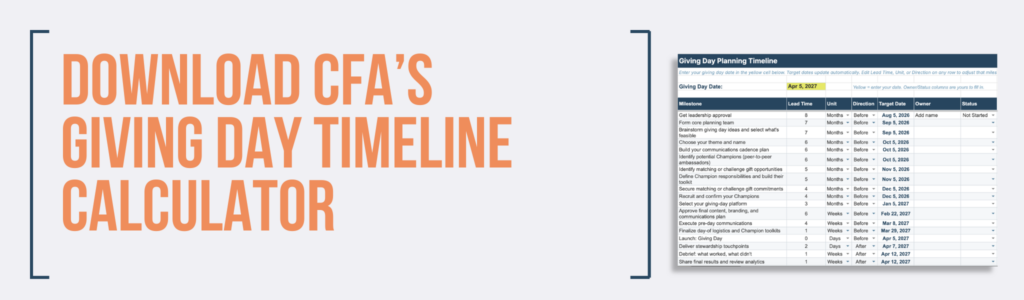
Plan your timeline: Enter your giving day date in our Giving Day Timeline Calculator and it calculates target dates for each milestone and outreach touchpoint.
Choosing a Platform and Building Champions

The planning committee settled on a branded name, Falcon Flight Day, tying the effort to Alderbrook’s mascot, and picked an ambitious but achievable first-year goal: 1,200 donors. Mila wanted Alderbrook’s first giving day to emphasize donor count rather than dollars, so a recent graduate’s gift would count as much as a longtime donor’s larger one. At the same time, she wanted to create an opportunity for the school’s most generous supporters to play a meaningful role.

“Matching gifts are one of the most reliable drivers of a giving day,” Rob says, “but organizations often overcomplicate them. The real power isn’t a strict dollar-for-dollar accounting exercise. It’s a messaging tool. A donor’s early commitment tells everyone else, ‘I believe in this enough to go first, and I want you to join me.'”

The committee’s strategy was to create a matching vehicle, funded by board members and longtime donors that unlocked in stages as the donor count climbed. Every 200 donors unlocked more of the matching funds, and meeting the goal of 1200 unlocked the whole matching grant. Counting donors instead of dollars enabled a $25 gift from a recent graduate to move the needle toward the next unlock as much as a $2,500 gift did. It was Mila’s answer to Vanessa’s math: A gift of any size could help release additional funds.

Rob also considers it essential to recruit “champions,” alumni and current students willing to post, email, and talk about the day in their own networks. “Institutional messaging alone will never generate the same energy as peer-to-peer outreach,” he says. “A good rule of thumb is roughly one champion for every ten donors you hope to reach, and I always encourage organizations to overbuild that number rather than come up short.”

Alderbrook started by recruiting champions from recent graduating classes — the same alumni who showed up for homecoming but rarely opened a fundraising email. Their job wasn’t to solicit gifts. It was to bring homecoming’s energy into people’s social feeds for one day.

Building Momentum Before the Day Arrives

With roles assigned and an online giving platform chosen, Mila’s committee created a layered communications plan: a save-the-date mailer a month out, followed by social posts and emails that increased in frequency. More pep rally than pledge drive, the messaging leaned into school spirit, but donors could opt to select programs or clubs they were especially interested in supporting.

“I also like offering people the chance to give early,” Rob says, “so that if someone can’t participate on the actual day, their gift still counts toward the total. That early momentum matters. When the day begins, and supporters can already see fifty gifts on the board, it tells everyone else that something real is happening, and they want to be part of it.”

The Results

Falcon Flight Day launched on a Wednesday in early May. By midnight, Alderbrook had welcomed 1,650 donors, including 480 who had never given to the university before, comfortably clearing its goal. They raised just over $310,000, and nearly a third of the day’s donors were graduates from the last decade.

In the days after Falcon Flight Day, Alderbrook’s committee sent personal thank-yous to every first-time and major donor, posted the final results publicly, and held a debrief to set a tentative date for next spring. For Mila, the follow-up mattered as much as the day itself. A giving day’s real value isn’t the one afternoon of energy. It’s whether the alumni it reaches show up the next year knowing their support counts. Rob sums it up simply: “Thoughtful stewardship is the most important thing you can do to turn a single gift into a habit of giving that endures.”

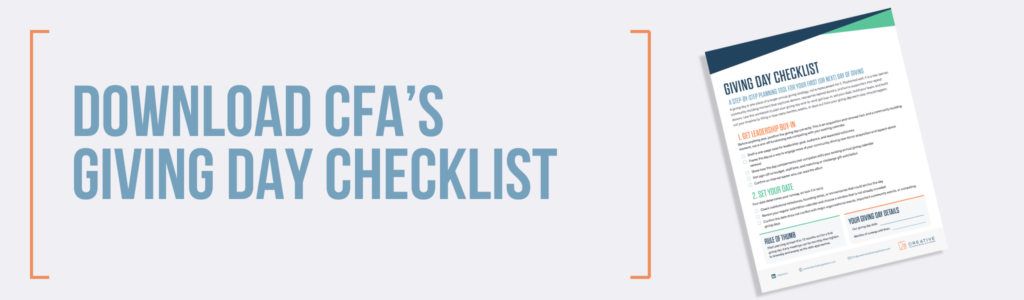
Get started: Download our Giving Day Checklist, a step-by-step worksheet for building your team, timeline, outreach cadence, and post-day stewardship plan.
Partner With Us

Is your organization considering a giving day, looking to strengthen annual giving, or trying to build a stronger pipeline of future supporters? Through a development assessment or strategic counsel, CFA can help you identify opportunities for growth and build fundraising strategies that create lasting momentum. Contact CFA today.

*Disclaimer: Client confidentiality is paramount in our work with each and every organization. The story in this article is fiction, based on real situations (or an amalgamation of several situations) drawn from CFA’s broad experience serving nonprofit organizations.

In Conversation with CFA: Inside Today’s Donor Mindset

CFA Chief Operating Officer Liz Jellema led a conversation with guests Rachel Hutchisson, Chair of the Communications Task Force at The Generosity Commission, and Rick Dunham, Founder of Dunham+Company and member of The Giving Institute. The philanthropy experts discussed recent fundraising trends, and what the findings mean for nonprofit organizations trying to raise more money and positively impact their communities.

Takeaways to Address Today’s Fundraising Trends

  1. Mind the Millennials.

    Giving by the Millennial age cohort (individuals who are between 27 and 42 years old in 2023) is on the rise, and their attitude about nonprofit organizations is positive. This finding comes from the most recent annual Giving by Generation study, conducted by Dunham+Company and published by Giving USA in 2023. The survey found that Millennial households gave 40% more, on average, to nonprofits in 2022 than they did in 2016. Another encouraging fundraising trend was the increase in the share of donors who believe that nonprofits are “doing a good job,” seen especially in the Millennial cohort who reported an 8% increase in confidence in nonprofits.

    At the same time, findings from a 2023 study of donors contributing at least $20 in online giving per year revealed that 62% of surveyed donors plan to reduce their 2023 giving from the previous year, citing economic uncertainty and the toll of inflation on their personal finances. When asked how to marry these two findings, Dunham stated, “It portends probably a slower growth rate of Millennial giving, but I’m still encouraged to see how Millennials have really jumped in more significantly as donors.” 

    The key takeaway about the Millennial mindset is that they are proving to be tomorrow’s dedicated donors. Understand how and how much Millennials are giving at your organization so that you can set a long range strategy for this group and tailor communications and appeals for best results.
  2. Monitor fundraising trends but focus on your own donor data management.

    A recent podcast by The Economist, “Give fast, spry young: the new philanthropists,” and a related article, “How a tide of tech money is transforming charity,” explored the idea that every generation has remade philanthropy, and how an up-and-coming cohort of young, wealthy tech entrepreneurs want to “move fast and fix things” by donating to moonshot ideas with expediency and without condition. 

    The webinar panelists agreed that while tech entrepreneurs represent an interesting segment of donors, they represent a relatively small percentage of the national donor pool. It is important to understand the interests of your current donors and use data insights to discover opportunities to connect prospective donors to your mission.

    Data helps reveal patterns that are happening over time so we can better understand donor behavior, including what motivates donors, and what methods of giving they prefer (such as being able to donate easily on a mobile device). This information helps you determine where to focus your fundraising resources. Nonprofits of all sizes must activate data management to understand what is happening with their own donors and take actions such as upgrading technology so that people can give via digital channels.

    Hutchisson explained that these studies help us “look at what’s happening overall, but just because it’s happening overall doesn’t mean it’s happening right in your microcosm. You also have to look at your own data. Look at who’s giving, how they’re giving, the different characteristics, and that just helps you understand the behaviors of your best donors, and behaviors of people who aren’t giving, and sets a little bit of direction for where to look and maybe how to invest.”
  3. Tell donors how their giving directly impacts your mission through storytelling.

    Donors want to see results, and they also want to help other people. In a 2020 Hidden Brain podcast called Happiness 2.0: Surprising Sources of Joy, Dr. Elizabeth Dunn of the University of British Columbia shared her finding that people feel a greater joy of giving when they know more about how their dollars are used. Jellema noted, “It seems fairly straightforward and intuitive, but people want to know that they’re making a positive impact and altering the course of life…If you can really hone in on your specific mission and what are you uniquely resourced to address, that will set you apart.”

    Hutchisson agreed and said, “We might care about data and plans and vision, but we also want to feel and see that we’re making a difference. We want to belong.” Instead of focusing on the transactional relationship of philanthropy or becoming too internally focused about what the organization is doing, appeal to your donors’ emotional connection with your mission through impact stories. Fundraisers will get better results when they use storytelling to reach various donor mindsets and illustrate outcomes related to giving. 
  4. Meet donors where they are with multichannel fundraising and communications. 

    Donors who engage in multiple channels—from direct mail to social media—give more often and are likely to give again. While organizations must embrace different communications channels, the core message needs to remain consistent, compelling, and – Dunham used the term “symbiotic” – or mutually reinforcing, across all channels. Blackbaud’s 2021 study about online fundraising trends found that donors become confused and frustrated when they receive a communication through one channel (such as direct mail) and then find a different message on the website. Leverage technology to determine which donors are responding to which appeals, and employ straightforward communication to donors via direct mail, text-to-give, and more. Nonprofits must invest in the infrastructure, staff, and training to effectively use these tools and make it easy for people to give.

Learn More

If you missed CFA’s webinar “Inside Today’s Donor Mindset,” click to view a recording:


For more, in-depth articles related to these topics, check out CFA’s Insights page. CFA can help your organization design and implement fundraising campaigns to engage a wider, deeper donor audience, communicate your “big idea,” evaluate your data, and ready your organization for transformational gifts. Contact CFA today for strategic fundraising counsel.

Developing Leadership Annual Giving to Drive Fundraising Success

By Rob Ruchotzke, Senior Consultant

What is Leadership Annual Giving?

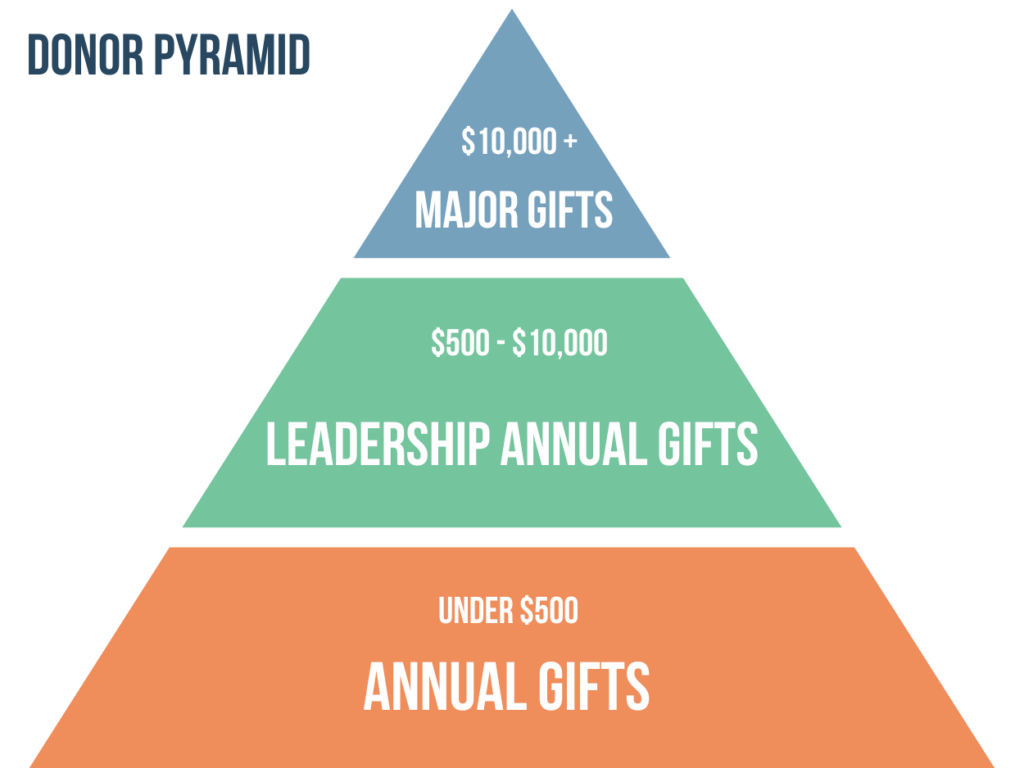
Leadership annual giving is a fundraising term used to describe a nonprofit’s largest repeating philanthropic gifts. Leadership annual gifts, also referred to as mid-level gifts, represent a higher dollar segment than that of baseline annual donors. Depending on the size of your organization, leadership annual gifts typically fall in the $500-$10,000 range. 

When conducting annual giving campaigns, nonprofit development professionals often focus on securing first-time gifts from the base of the donor pyramid or renewing major gifts from the top of the donor pyramid; however, gifts at the the middle of the donor pyramid are just as important. By strategically cultivating and stewarding mid-level donors for leadership annual gifts, you can increase their engagement and position your organization to ask for larger major gifts.  

  • Of note: According to the December 2022 AFP Fundraising Effectiveness quarterly report, annual gifts between $500-$5,000 are generated from 14% of donors and make up over 16% of total dollars raised, while gifts of $5,000+ are generated from a much smaller pool of 2.6% of donors but make up 74% of total dollars raised. 

Leadership Annual Giving Tactics to Raise More Money

The following are my go-to recommendations for clients looking to increase their leadership annual giving:

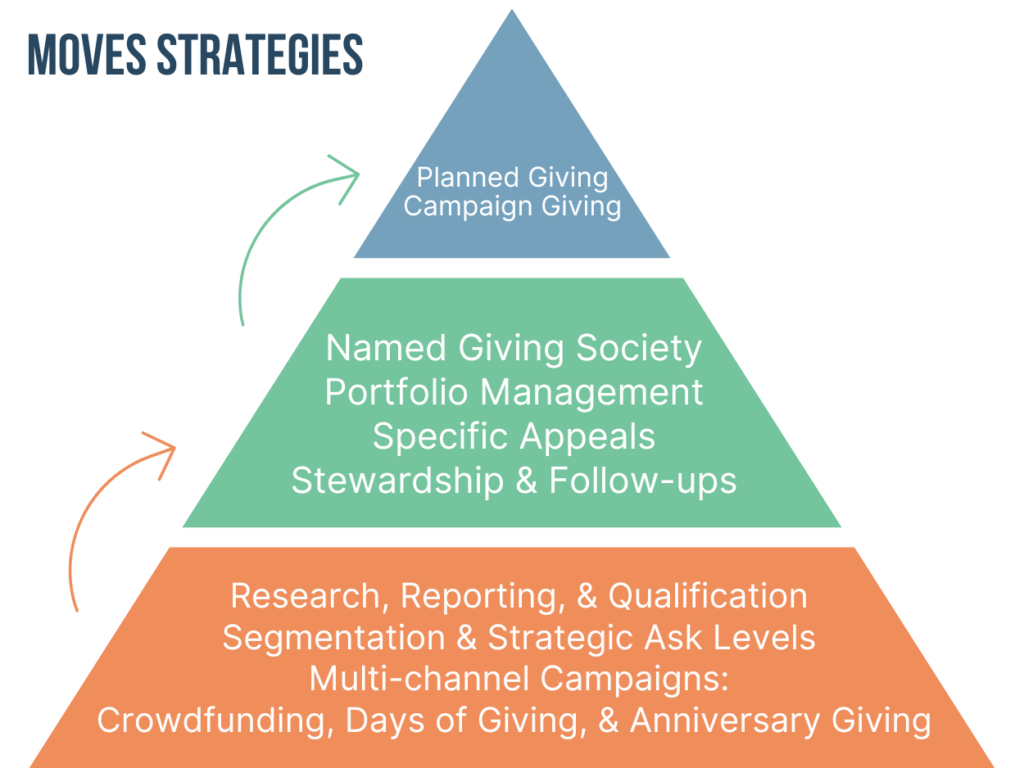
1. Strategize and cultivate leadership annual giving donors through regular follow-ups utilizing a donor cultivation cycle to manage the donor journey. Assign staff members who have relationship-building skills to your top donors and prospects to personally engage with them and cultivate future gifts. 

2. Monitor leadership annual giving by consistently collecting and analyzing donor data. Tracking giving patterns can help determine the appropriate time to solicit for larger major gifts within your donor moves management system.

3. Launch a giving society for your organization with named giving tiers, such as: Sustainer ($500-$999 per year), Influencer ($1,000-$2,499 per year), Investor ($2,500-$4,999 per year), Founder ($5,000+ per year). Providing meaningful benefits and recognition opportunities can motivate your donors to keep giving and to move up to the next level.

  • Consultant Tip: Host invitation-only events for the giving society to acknowledge leadership annual donors as well as public events where they can invite friends who have the potential to be future donors.

4. Conduct a comprehensive development assessment to analyze your current fundraising efficiencies, and/or a campaign feasibility study if your organization is considering a capital, endowment, or capacity building campaign. Both of these processes can reveal insights about the overall health of your organization’s fundraising practices and opportunities for improvements.

5. Align your frontline fundraising team by setting internal goals and reporting fundraising progress. Set a reasonable number of prospects for each of your gift officers’ portfolios, depending on the scope of the gift officer’s role, the size of your organization, and the goal of your campaign. Set a dollar goal for each gift officer to reach and celebrate wins along the way. 

6. Make donating to your organization as easy and seamless as possible by leveraging a variety of fundraising channels, including mobile giving, mailed forms, and online giving pages connected to your donor database. Keep messaging specific and consistent across various fundraising platforms to clearly convey the ask. 

7. Communicate with your donors to convey the impact of their gifts: once a donor contributes a leadership annual gift, they must be promptly thanked and informed of what has been made possible through their contribution. Connect via phone or video calls, thank-you letters, social media, and in-person meetings. Once a donor has made a leadership annual gift, consistent and regular donor communication is one of the best ways your organization can retain donors and increase future gifts.

Leveraging leadership annual giving is crucial for cultivating a robust pipeline of stable and increasing philanthropic support. Contact Creative Fundraising Advisors today to discuss how we can partner with you to achieve your goals.


Rob Ruchotzke

Rob Ruchotzke, Senior Consultant

Rob Ruchotzke focuses on annual giving strategy, development assessments, campaign feasibility studies, and campaign counsel. Rob comes to CFA with nearly a decade of annual giving experience in higher education institutions. Most recently, Rob served as the director of annual giving at the University of Northern Iowa (UNI), where he led multichannel campaigns, developed crowdfunding platforms, managed annual giving vendors, and served as the strategy lead for UNI’s Day of Giving (#LivePurpleGiveGold). A native of Camanche, Iowa, Rob holds a BA in Public Relations from the UNI and resides in Cedar Falls, Iowa.

Email Rob

Rob Ruchotzke Joins Creative Fundraising Advisors as Consultant

August 15, 2022

Creative Fundraising Advisors (CFA) is pleased to announce that Rob Ruchotzke has joined the firm as Consultant, where he will focus on annual giving strategy, development assessments, campaign feasibility studies, and campaign counsel. Ruchotzke comes to CFA with nearly a decade of annual giving experience in higher education institutions and brings a passion for building relationships to find solutions for CFA’s partners.

States CFA Principal Jake Muszynski, “Rob’s expertise is a tremendous asset to the company, and he brings new perspective that is key to CFA’s ability to provide fundraising strategy for all giving levels within an organization.”

Ruchotzke began his career at Ruffalo Noel Levitz as a project center manager for Missouri University of Science and Technology (Missouri S&T) and then as an annual giving officer with the Missouri S&T Advancement team. Most recently, Ruchotzke served as the director of annual giving at the University of Northern Iowa (UNI), where he led multi-channel campaigns, developed crowdfunding platforms, managed annual giving vendors, and served as the strategy lead for UNI’s Day of Giving (#LivePurpleGiveGold).

A native of Camanche, Iowa, Ruchotzke holds a BA in Public Relations from the University of Northern Iowa and currently resides in Cedar Falls, Iowa where he enjoys spending time outdoors.

States Ruchotzke, “I am excited to join the CFA team and their many partners. Philanthropy and annual giving are passions we all share, and I am eager to implement what I have learned to impact our partners, communities, and organizations at a fundamental level.”

Since CFA was founded in 2015, it has grown from sole practitioner practice to a full-service, nationally focused, strategic fundraising firm with clients in arts and culture, education, environment, and human services sectors. CFA’s client base includes The Entertainment Community Fund (New York), Philadelphia Contemporary (Philadelphia), Trinity Park Conservancy (Dallas), St. John’s College (Annapolis), Northside Achievement Zone (Minneapolis), North Carolina Museum of Art (Raleigh), Friends of the Mississippi River (Minneapolis), Mitchell Hamline School of Law (St. Paul), Sycamores (Los Angeles), Headlands Center for the Arts (San Francisco), Santa Fe Community Foundation (Santa Fe), Santa Fe School for the Arts & Sciences (Santa Fe), Academy Museum of Motion Pictures (Los Angeles), AltaSea at the Port of Los Angeles (Los Angeles), Street Poets (Los Angeles), and numerous others.