

For eight years, Mila has been the Director of Annual Giving at Alderbrook University*, a regional institution in the Northeast with a $160 million annual operating budget and roughly 6,000 undergraduate and graduate students. Alumni Relations and Advancement maintained connections to around 100,000 alumni and supporters.
At the homecoming game, Mila found herself chatting with Vanessa, a young alumna, three years out, dressed head-to-toe in Alderbrook blue. When Mila asked Vanessa if she had given any consideration to the college’s recent appeals, the alumna paused for a beat. “I love this,” she said, gesturing toward the crowd. “But those appeals aren’t really talking to me. They’re for someone ten or fifteen years further along, someone who can write a real check. What am I going to give, twenty dollars? That’s not going to make a difference.”
The comment stayed with Mila. It wasn’t apathy she had heard, but a graduate who showed up for anything that felt like community, having decided her gift would be too small to matter.
What a Giving Day Actually Is
Mila began looking into whether the “giving day” concept that she’d heard about at conferences but never seriously considered might reach alumni like Vanessa. It’s a question Creative Fundraising Advisors’ Senior Consultant Rob Ruchotzke fields often.
“A ‘giving day’ is different from GivingTuesday,” Rob explains. “National days of giving put every nonprofit in competition for attention on the same day. A giving day belongs to one institution and leans on peer-to-peer outreach and stories tied to that place, so there’s far less noise to cut through.” The format is especially common in higher education, where alumni identity and school pride already give institutions something to rally around, though it adapts well to other kinds of organizations.
Where It Fits in the Bigger Picture
Rob is careful to frame a giving day as one piece of a larger annual giving strategy, not a replacement for it. “Most giving-day gifts land in the same range as other annual gifts,” he says. “The real value is as an acquisition and reacquisition tool. It’s a visible, low-barrier moment that can reengage a lapsed supporter, or turn someone who’s never given at all into a first-time donor.”
Giving days also let institutions engage supporters more than once a year for different purposes, he notes: “Organizations might ask for an annual fund gift in the fall, then a giving-day gift in the spring directed toward a program relevant to the donor. The two appeals should build on each other rather than compete.”
Building the Right Team
For institutions contemplating their first giving day, Rob recommends forming a small planning committee with a range of roles and experience. Some members might play more than one of the following roles:
- A communications lead who determines external messaging and channels
- An annual giving, community engagement, or alumni representative with direct relationships to your constituents
- An experienced fundraiser who can speak convincingly to the mission and the ask
- A project manager who can build a realistic timeline and keep the work on track
“I’d start planning at least six to twelve months out for a first giving day,” Rob notes. “Early meetings can be monthly, then tighten to biweekly and weekly as the date approaches.”
Once Mila had determined that a giving day would be a good fit for Alderbrook, she assembled a planning committee that included a communications officer, an alumni relations staffer, and another fundraiser from Mila’s team who also served as the project coordinator. They gave themselves eight months; the alumni relations staffer’s first assignment was to begin recruiting ambassadors for peer-to-peer outreach. The appeal would target the entire alumni base, but Mila wanted alumni like Vanessa to feel it was speaking to them, too.
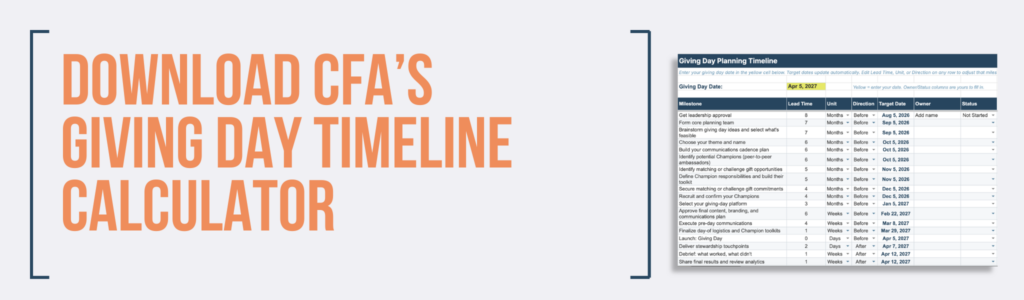
Plan your timeline: Enter your giving day date in our Giving Day Timeline Calculator and it calculates target dates for each milestone and outreach touchpoint.
Choosing a Platform and Building Champions
The planning committee settled on a branded name, Falcon Flight Day, tying the effort to Alderbrook’s mascot, and picked an ambitious but achievable first-year goal: 1,200 donors. Mila wanted Alderbrook’s first giving day to emphasize donor count rather than dollars, so a recent graduate’s gift would count as much as a longtime donor’s larger one. At the same time, she wanted to create an opportunity for the school’s most generous supporters to play a meaningful role.
“Matching gifts are one of the most reliable drivers of a giving day,” Rob says, “but organizations often overcomplicate them. The real power isn’t a strict dollar-for-dollar accounting exercise. It’s a messaging tool. A donor’s early commitment tells everyone else, ‘I believe in this enough to go first, and I want you to join me.'”
The committee’s strategy was to create a matching vehicle, funded by board members and longtime donors that unlocked in stages as the donor count climbed. Every 200 donors unlocked more of the matching funds, and meeting the goal of 1200 unlocked the whole matching grant. Counting donors instead of dollars enabled a $25 gift from a recent graduate to move the needle toward the next unlock as much as a $2,500 gift did. It was Mila’s answer to Vanessa’s math: A gift of any size could help release additional funds.
Rob also considers it essential to recruit “champions,” alumni and current students willing to post, email, and talk about the day in their own networks. “Institutional messaging alone will never generate the same energy as peer-to-peer outreach,” he says. “A good rule of thumb is roughly one champion for every ten donors you hope to reach, and I always encourage organizations to overbuild that number rather than come up short.”
Alderbrook started by recruiting champions from recent graduating classes — the same alumni who showed up for homecoming but rarely opened a fundraising email. Their job wasn’t to solicit gifts. It was to bring homecoming’s energy into people’s social feeds for one day.
Building Momentum Before the Day Arrives
With roles assigned and an online giving platform chosen, Mila’s committee created a layered communications plan: a save-the-date mailer a month out, followed by social posts and emails that increased in frequency. More pep rally than pledge drive, the messaging leaned into school spirit, but donors could opt to select programs or clubs they were especially interested in supporting.
“I also like offering people the chance to give early,” Rob says, “so that if someone can’t participate on the actual day, their gift still counts toward the total. That early momentum matters. When the day begins, and supporters can already see fifty gifts on the board, it tells everyone else that something real is happening, and they want to be part of it.”
The Results
Falcon Flight Day launched on a Wednesday in early May. By midnight, Alderbrook had welcomed 1,650 donors, including 480 who had never given to the university before, comfortably clearing its goal. They raised just over $310,000, and nearly a third of the day’s donors were graduates from the last decade.
In the days after Falcon Flight Day, Alderbrook’s committee sent personal thank-yous to every first-time and major donor, posted the final results publicly, and held a debrief to set a tentative date for next spring. For Mila, the follow-up mattered as much as the day itself. A giving day’s real value isn’t the one afternoon of energy. It’s whether the alumni it reaches show up the next year knowing their support counts. Rob sums it up simply: “Thoughtful stewardship is the most important thing you can do to turn a single gift into a habit of giving that endures.”
Get started: Download our Giving Day Checklist, a step-by-step worksheet for building your team, timeline, outreach cadence, and post-day stewardship plan.
Partner With Us
Is your organization considering a giving day, looking to strengthen annual giving, or trying to build a stronger pipeline of future supporters? Through a development assessment or strategic counsel, CFA can help you identify opportunities for growth and build fundraising strategies that create lasting momentum. Contact CFA today.
*Disclaimer: Client confidentiality is paramount in our work with each and every organization. The story in this article is fiction, based on real situations (or an amalgamation of several situations) drawn from CFA’s broad experience serving nonprofit organizations.